Alberta landfill operators face environmental charges

The Alberta government has laid charges against the Town of Whitecourt and Woodlands County, which operate the the Whitecourt Regional Solid Waste Management Authority, for offences under the Environmental Protection and Enhancement Act. The Authority operates the Whitecourt Regional landfill, which is 17 kilometres east of Whitecourt.

According to the Government of Alberta, the Town of Whitecourt has been charged with 18 counts and Woodlands County has been charged with 12 counts under the act for contravening terms or conditions of their approval and for taking actions at the landfill that required amendments to their approval. The charges relate to events that occurred between September 12 and November 28, 2016.

The charges include:

  • Knowingly contravening a term or condition of an approval, contrary to section 227(d) of the Environmental Protection and Enhancement Act.
  • Contravening a term or condition of an approval, contrary to section 227(e) of the Environmental Protection and Enhancement Act.
  • Making a change to an activity, the manner in which it is carried on, or any machinery, equipment or process that is related to the carrying on of the activity unless an approval or an amendment to an approval authorizing the change is issued, contrary to section 67(1) of the Environmental Protection and Enhancement Act.

Alberta Environment and Parks spokesperson Jamie Hanldon told the CBC that: “There was not a risk to the public; these are all procedural matters.”

The first court appearance is set for October 23 in Whitecourt Provincial Court.

For more information, visit: www.alberta.ca

Canadian NOx emitters, what’s your plan for MSAPR compliance?

By Françoise Robe and Kirk Easto, RWDI

Under the new Multi-Sector Air Pollutants Regulations (MSAPR), many Canadian operations face strict and rather onerous reporting requirements of their nitrogen oxides (NOx) emissions.

The MSAPR apply to Boilers and Heaters (Part 1), Stationary Spark-Ignition Engines (Part 2), and Cement Kilns (Part 3). Your reporting deadline depends on the type and size of the sources and when they were put into operation.

RWDI has been actively sharing ideas about how you can adapt to this major revision of the Air Quality Management System (AQMS), with various seminars and most recently at CANECT18 where RWDI senior project manager and principal Brad Bergeron co-chaired a session on managing industrial air emissions, featuring speakers from Environment Canada, as well as experts from RWDI and other firms.

Think about a complete shift in practice

As you consider your plan for responding to this regulation, you may find it helpful to adopt a mindset of completely shifting your practice. As we see it, these are the biggest changes you’ll need to make under the new laws:

  • Testing is key. You can no longer simply use manufacturers’ data.
  • Frequent reporting is required. You must show that equipment continues to meet the standards, so you’ll need to plan for more frequent testing to document compliance.
  • Testing methodology is strict. The regulations stipulate strict test requirements, including port specifications and operating conditions. This change means that you’ll need to plan ahead to meet the test conditions within your operating schedule. We have put together checklists to help you prepare and ensure efficient and compliant testing sessions.

Complying with MSAPR is, without question, a significant endeavour. But by making informed choices, you may find opportunities for savings.
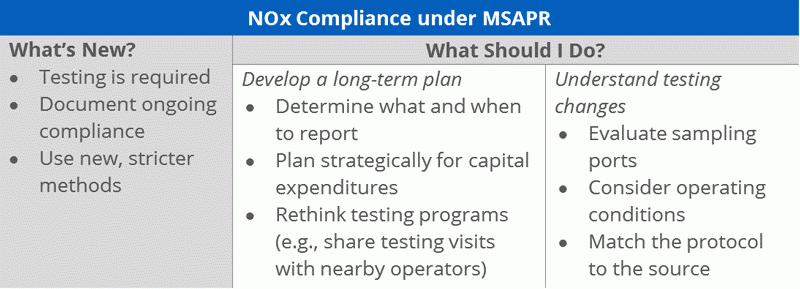
NOx compliance under MSAPR

A long-term, big-picture strategy is critical

To make effective choices about MSAPR compliance, you need to start from three foundations:

  • Correct interpretation of the regulation
  • Comprehensive, long-term planning
  • Good source data (i.e., accurate, appropriate to the source and sufficiently comprehensive).

Determine what and when to report. You’ll need to understand in detail how the regulation applies to your operation’s unique profile. First and foremost, your portfolio of sources will determine when and how often you need to report. However, the deadlines are not straightforward and vary by source.

Plan strategically for capital expenditures. You may need to reconsider your capital equipment plans with a view to retiring your worst sources sooner than expected.

Rethink testing programs for accuracy and efficiency. Your reporting profile will guide your choice of new systems and procedures for testing and reporting. For the looming near-term deadlines, you may want to share testing visits with nearby operations facing the same time pressures. Shared scheduling may save everyone time and money.

In the longer term, it may help to see opportunity in necessity. Invest now to develop an efficient ongoing testing program, and you’ll save money and headaches in the coming years. For example, you may need to look for easy ways to keep more comprehensive historical records, because the regulation uses the operational date as a criterion. You may also need new kinds of source inventories, methodologies and testing schedules.

Because this regulation requires so much more actual testing, another long-term strategy may be to start or enhance in-house testing capabilities. For example, local staff could be trained to perform routine stack testing.

 Françoise Robe and Kirk Easto are with RWDI. For more information, visit: www.rwdi.com/en_ca/expertise

CANECT 2018 course highlights

We’ve highlighted important topics and developments that were discussed at CANECT 2018 courses. Thank you to Bennett Jones LLP for their help with this summary.

Spill and Release Reporting

Is this a spill? Is this a reportable release? What should you consider when reporting an incident to a regulator?  There are many important questions that have to be considered in the context of an environmental release.  There are multiple reporting obligations under Federal and provincial environmental laws – even municipal bylaws.   As a general rule, spills and releases must be reported to regulators immediately.  Failure to report a reportable release on time can, and often does, result in enforcement from the regulator.  Do you have procedures in place to ensure that environmental incidents are identified and communicated to the appropriate person for reporting to the regulator?  We discussed best practices and potential pitfalls with respect to spill and release reporting.

Excess Soil Developments

The Ontario Ministry of the Environment and Climate Change (MOECC) is in the process of overhauling how excess soil is managed in the province. Proposed regulations and guidance documents have been posted to the Environmental Registry.

Excess soil is soil that has excavated as part of a project and removed from the project area. Excess soil would be designated as a “waste” and subject to the EPA’s waste provisions if the excess soil leaves the project area and is not reused in accordance with the new rules, including that the soil complies with the quality and quantity requirements in a site specific instrument or as prescribed by regulation and the soil is to be used for beneficial purpose (i.e., the reuse site is not used primarily for depositing soil).  Expect to see expanded responsibilities for project leaders and qualified persons (QPs), who would be required to prepare excess soil management plans before the soil leaves the project area. The new excess soil regime is expected to come into force between January 1, 2020 and January 1, 2021.

MOECC- What’s next for environmental permissions?

The MOECC’s Business Transformation Branch presented at CANECT to discuss the environmental permissions programs.  This year, the MOECC announced a one year service standard for the review of Environmental Compliance Approval (ECA) applications received after 2017.  Last year, O. Reg. 1/17, known as the Air Emissions Environmental Activity and Sector Registry (EASR) Regulation, authorized a large number of facilities in the province to approve their air emissions through the EASR. Together, these modernization processes have been introduced to reduce the regulatory burden on businesses requiring environmental permissions.  The MOECC continues to review opportunities for efficiencies in the delivery of the environmental permissions programs.  Stay tuned for future developments relating to potential EASRs and program enhancements, including short-term water takings EASRs, brownfield service delivery model developments, and e-service delivery for Permits to Take Water (PTTW), Hauled Sewage and Pesticides Licensing.

Stay tuned for more CANECT course summaries and industry news. If you’d like to suggest topics for future CANECT courses, click here to email us.