Guest Blog Post from the Standards Council of Canada
Canada plays an active role in the development of international standards through participation in ISO/TC 207 – Environmental Management. Canadian mirror committees (MCs) provide national expertise and perspectives to support the development of both globally and nationally recognized environmental standards.
Opportunities are currently available for volunteer expert members to join the following Canadian mirror committees:
These committees contribute to the development of standards that help organizations manage environmental responsibilities, conduct effective audits, and evaluate environmental performance. Participation offers professionals a unique opportunity to influence the direction of global environmental best practices.
Time Commitment: Approximately 3 hours per quarter, with flexibility to accommodate your professional schedule.
If you are an environmental professional passionate about standards and sustainability, the Standards Council of Canada (SCC) encourages you to get involved.
To learn more or express your interest, please apply through the SCC links provided in the committee names above.
By George Jaikaran, Environmental Analyst, Environmental Stewardship Team Leader, RWDI
Extended producer responsibility (EPR), commonly referred to as environmental stewardship or green accounting, is a policy strategy where producers must take responsibility for the end-of-life management of their products (recycling and disposal fees) once they have served their usefulness to consumers. EPR is often delivered through government legislation, though it can also be implemented on a voluntary basis.
So who exactly does this apply to?
Under EPR, the term “producer” refers to the brand owner, first importer, or retailers of products that are resident in the province, state, or country they are being sold in. The packaging they come in, or the product itself, may be subject EPR fees (sometimes called eco-fees). Common types of companies that are considered producers include consumer product manufacturers, distributors of consumer goods, and retailers. Products (or goods) can be targeted items (e.g., solvents, electronics, batteries, tires, and paints) or the packaging that ends up in the residential waste collection system.
Photo credit: RWDI
Producers and the Cost of Extended Producer Responsibility
Embracing EPR, whether it is through mandatory compliance to legislation or the voluntary implementation of an appropriate program, comes with cost. EPR requires producers pay regulatory fees to account for the cost of recycling and otherwise handling the post-consumer materials. In many jurisdictions, producers generating a minimum revenue of $2 million annually are responsible for paying fees to the regulatory EPR program in their area. Of course, EPR programs are constantly evolving and new programs are appearing all the time. Thus, simply because a producer may not be obligated to report now, they could very well be required to do so in the future.
In many cases, producers add the environmental costs of a product throughout its life cycle to its market price to help offset these fees. This often happens in the form of recycling fees or environmental handling fees, or eco-fees, such as those found on receipts for electronics or batteries.
Although there is a cost to EPR, it offers several benefits, particularly as part of the circular economy.
The Circular Economy and Benefits of EPR
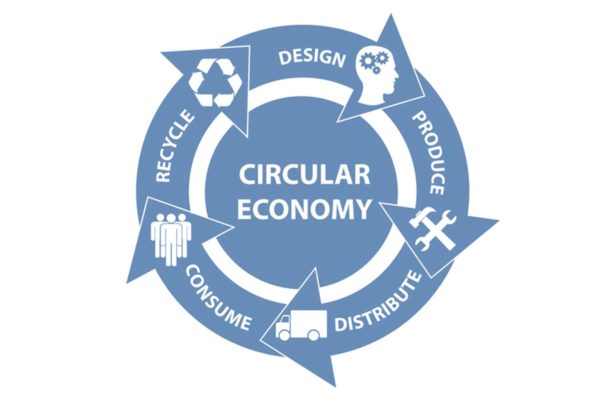
At its core, the circular economy is a system that looks to reduce and even eliminate pollution and waste throughout the lifecycle of products and materials. This is often done by keeping products in use as long as possible by using sustainable materials that can be recycled at their end-of life and either reused in other industrial processes or, where possible, returned safely back to the environment – which is what creates a natural regenerating system.
There are other stages to this type of economy as well, such as businesses working to reduce their greenhouse gas production and use of other fossil fuels during the product production phase, offering take-back and repair programs during distribution, and recovering materials throughout a product’s lifecycle.
So how does this relate to EPR?
EPR provides significant benefits that fit extremely well within the circular economy. Two intertwined benefits are the support that EPR provides regarding waste reduction and an increased focus onto reuse and recycling activities. For instance, producers have changed their product packaging to not only reduce their environmental impact, but also increase their cost-efficiency as it relates to EPR.
Such changes can include choosing more sustainable materials, including compressed cardboard with a special plastic laminate rather than complete plastic for packaging. Not only is this a change to a lighter material, which as a result reduces the cost the producer must pay to the EPR program authority, but it is also easier to recycle and reuse when it reaches end-of-life.
How RWDI is Helping Clients Contain Costs
RWDI offers significant cost savings to producers subject to EPR regulations. This comes through an analysis to develop site-specific databases during the process of ensuring EPR compliance. These databases inform the preparation of the necessary reports and manages fees to the agency delivering the EPR program.
RWDI’s expert analysis include an annual review of the materials and therefore, the cost of EPR compliance, allowing us to identify where the costs are coming from as well as the options for reducing them. Even further down the road, RWDI can assess the impact of potential changes to packaging, even before any changes are made.
Understanding extended producer responsibility is becoming increasingly more important, as legislated extended producer responsibility programs are being implemented in more jurisdictions every day, including the Blue Box Regulation in Ontario. For more information on extended producer responsibility and how RWDI can help with compliance, check out our Environmental Stewardship service or contact George Jaikaran, Environmental Analyst and Environmental Stewardship Team Leader.
Related Professional Development Course
Learn more about federal, provincial and municipal rules governing extended producer responsibility from expert speakers, including George Jaikaran, by attending the CANECT course: “Environmental Regulation & Compliance 2022”. This course is being held on April 26, 2022 in Vaughan, Ontario as part of the 28th annual CANECT Environmental Compliance and Due Diligence Training Event. Visit the CANECT website to learn more.
By Alan Harvie and Kellie L. Johnston, Norton Rose Fulbright Canada LLP
On March 30 and March 31, Alberta’s minister of environment and parks passed a slew of ministerial orders (the Orders) modifying certain industrial environmental reporting requirements in Alberta. The Orders were passed pursuant to s. 52.1(2) of the Alberta Public Health Act and are further to order-in-council 080/2020 that declared a state of public health emergency in Alberta due to the COVID-19 pandemic.
Ministerial order 15/2020
Ministerial order 15/2020 extends the deadline to submit compliance reports and emissions reduction plan reports under sections 36(8) and 36(9) of Alberta’s Technology Innovation and Emissions Reduction Regulation from March 31, 2020, to June 30, 2020. Ministerial order 15/2020 can be found here.
Ministerial order 16/2020
Ministerial order 16/2020 extends the deadline to submit reports for the 2019 compliance period under sections 10(1), 11(1) and 12(1) of Alberta’s Renewable Fuels Standard Regulation from March 31, 2020, to June 30, 2020. These new deadlines apply to fuel suppliers, approved contributors and renewable fuel providers. Ministerial order 16/2020 can be found here.
Ministerial order 17/2020
Ministerial order 17/2020 suspends all requirements to report information pursuant to provisions in approvals or registration under the Alberta Environmental Protection and Enhancement Act and all requirements to report information pursuant to provisions in licences or approvals under the Alberta Water Act. These suspensions do not apply to reporting requirements for drinking water facilities. Ministerial order 17/2020 also suspends all disposition requirements to submit returns or reports under the Alberta Public Lands Act.
Notwithstanding these suspensions, all approval, registration, licence and disposition holders (Record Holders) are required to continue to record and retain complete information relating to any reporting or return requirements. Upon request, the Record Holders are required to make these records available to Environment and Parks, or the Alberta Energy Regulator where the records deal with energy resource activities. Ministerial order 17/2020 can be found here.
Duration
The Orders shall remain in effect, unless they are sooner continued by an order of the lieutenant governor in council under the Alberta Public Health Act, until the earliest of:
a. August 14, 2020;
b. 60 days after order-in-council 080/2020 is terminated by the lieutenant governor in council, if order-in-council 080/2020 is terminated before June 15, 2020; or
c. the termination of the Orders by the minister or the lieutenant governor in council.
Temporary amendment to select Air Monitoring Directive requirements
In addition to the Orders, on March 31, Alberta Environment and Parks also issued a temporary amendment to select Air Monitoring Directive (AMD) requirements. The amendment allows industrial operations and Alberta airsheds to deviate from select AMD monitoring, siting and reporting requirements. Effective immediately:
i. calibration of ambient analyzers and ambient station manifold and inlet cleaning is now required once every three months for the remainder of 2020;
ii. the requirement to report “calendar day” in AMD reporting forms is removed;
iii. the deadline to complete and submit the 2019 Annual Emissions Inventory Report is extended from September 30, 2020, to December 31, 2020;
iv. the requirement to immediately report exceedances of Ambient Air Quality Guidelines until August 31, 2020, is removed until September 30, 2020;
v. extending until September 30, 2020, the requirement to submit airshed monthly monitoring summary reports and ambient data is extended by two months.
More detailed information on the amendments to the AMD requirements in Alberta, and their specific application, can be found here.
As of April 2, Alberta is the only province that has suspended certain environmental reporting requirements in response to the COVID-19 pandemic. Earlier, on March 26, the assistant administrator for enforcement and compliance assurance at the US Environmental Protection Agency unveiled its own policy to deal with environmental non-compliance in the wake of COVID-19, announcing that the agency would apply enforcement discretion for noncompliance: (i) during the period of the policy; (ii) that results from the COVID-19 pandemic. More information on this policy can be found here.
Additional information on tips to manage environmental risk during the time of the COVID-19 pandemic can be found here.